
Ever since I was a young boy, I've been fascinated by old black and white photographs of the iconic stone figures high on the towers of Notre-Dame Cathedral in Paris. Like most people, I knew them simply as gargoyles, only discovering years later that they are actually chimeras, decorative sculptures rather than true gargoyles, which act as waterspouts. Long before I ever visited the city, I knew that one day I wanted to stand beside them with a camera.
When fire tore through Notre-Dame in 2019, I honestly wondered if that dream had disappeared forever. Thankfully, years of painstaking restoration have brought visitors back, and booking a tower climb became one of the first things I organised when planning this trip. If you're visiting Paris, I would strongly recommend booking in advance and paying the small additional fee to climb the towers. It's an experience you won't regret.
The climb itself is straightforward, but it can be challenging. More than 400 narrow stone steps spiral their way to the top, and by the time you emerge onto the gallery, you'll know you've earned the view. Fortunately, any tired legs are quickly forgotten as Paris opens up before you and those familiar stone figures finally appear just a few feet away.
Photographically, there are fewer opportunities than you might expect. If you want the classic view overlooking Paris, there's currently only one real viewpoint. The route through the towers is fixed, and protective mesh and safety barriers restrict where you can position yourself, so everyone is essentially working from the same place. The challenge isn't finding a unique angle but making the very best of the light and carefully composing the scene.
This was an occasion where the iPhone genuinely proved to be an advantage. Its compact size made it much easier to manoeuvre around the protective mesh and narrow walkways, allowing me to position the camera exactly where I wanted it. Shooting in ProRAW also gave me the flexibility to recover detail from the bright Paris skyline while retaining texture in the deep shadows of the stone. In truth, processing the image afterwards was more challenging than climbing the steps.
The light is probably the biggest photographic challenge. By the time the towers open, particularly during summer, the sun is already quite high, creating deep shadows on the sculptures and bright highlights across the city. Looking back, if I ever return, I'd be tempted to book an afternoon visit instead. The, lower light and angle should give the stone more shape and texture while bathing the Paris skyline in a softer glow.


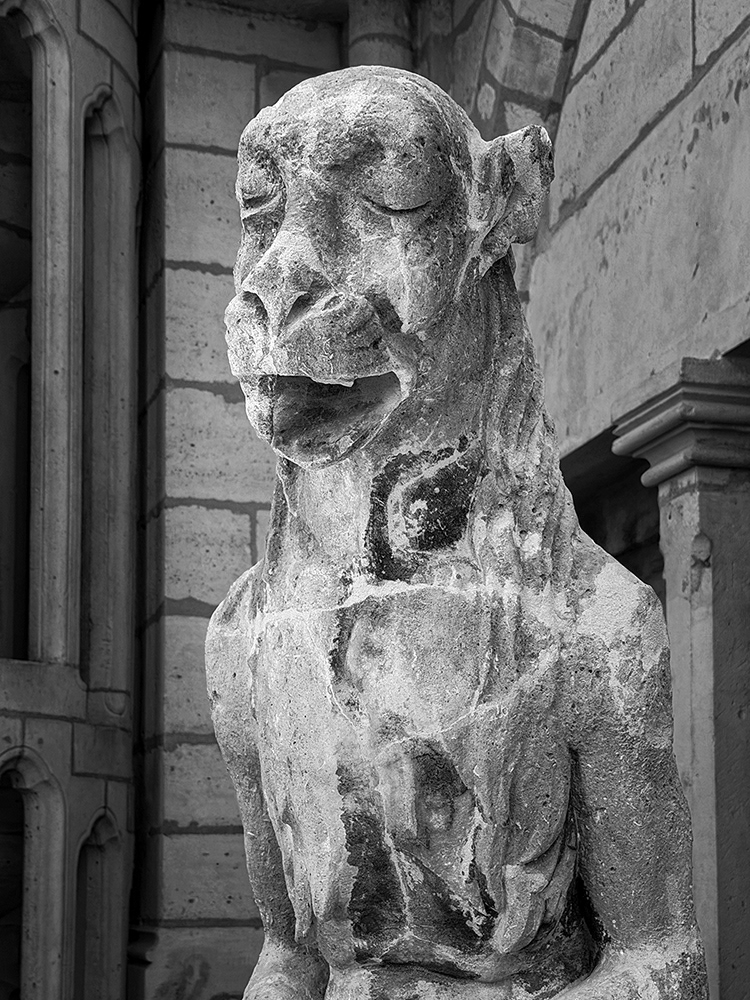
I chose to finish the image in black and white, not because the colour wasn't beautiful, but because it took me back to those photographs that first captured my imagination all those years ago. Monochrome strips away the distractions of the modern city and lets the age, texture and timeless character of the scene take centre stage.
Some photographs are about discovering somewhere new. Others are about finally making a photograph you've carried in your imagination for decades.
For me, this was one of those photographs. It took more than sixty years to make, and every single step was worth it.